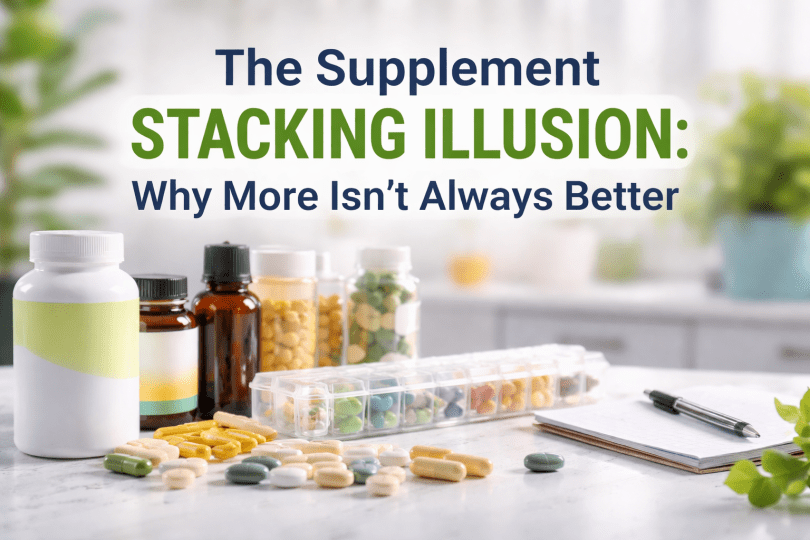
The Supplement Stacking Illusion: When “More” Quietly Works Against You

Walk into any health store or scroll through wellness content online and you will see the same message repeated in different forms: optimize everything. Boost your immune system. Upgrade your mitochondria. Enhance detox. Support stress. Improve cognition. Increase longevity.

The underlying assumption is simple: if a little is good, more must be better.

That assumption deserves to be challenged.

The human body is not improved by constant biochemical pressure. It is regulated by balance. When we start stacking dozens of supplements without clear purpose or measurement, we are no longer practicing wellness. We are practicing unsupervised pharmacology.

Supplements Correct Deficiencies — They Don’t Replace Wisdom

Let’s be clear. Vitamins and minerals matter. Severe vitamin D deficiency increases fracture risk and weakens immune function. Iron deficiency causes anemia. Magnesium deficiency affects muscle and nerve stability.

When there is a true deficiency, supplementation is appropriate and often necessary.

The problem begins when sufficiency turns into excess.

Vitamin D taken well beyond physiological need has been associated with elevated calcium levels and kidney stone risk.1 Chronic high-dose zinc can block copper absorption and eventually lead to anemia or neurological issues.2 Long-term high vitamin B6 intake has been linked to nerve damage.3 Iron supplementation without deficiency increases oxidative stress and may increase infection risk.4

Nutrients are powerful. They operate safely within ranges. When we push beyond those ranges without reason, they behave more like drugs than food.

The Antioxidant Myth: When Fighting Oxidation Goes Too Far

We have been taught that oxidation is bad and antioxidants are always good. That message is incomplete.

Your body actually uses small amounts of oxidative stress as signals. These signals help regulate energy production, immune response, and adaptation to exercise.

Research shows that taking high-dose antioxidants can blunt some of the beneficial adaptations from exercise.5 There is also growing research around something called “reductive stress,” which happens when the system is pushed too far in the opposite direction by excessive antioxidant input.6

Compounds such as alpha-lipoic acid, N-acetylcysteine (NAC), high-dose vitamin C, and glutathione are often stacked together under the assumption that more cellular protection is always better. But alpha-lipoic acid can enhance blood sugar lowering, which may be risky if someone is already on diabetes medication.7 NAC interacts with certain cardiovascular medications.8 High-dose vitamin C has been associated with increased kidney stone risk in some individuals.9

Antioxidants are tools. Tools are helpful when used appropriately. They are not meant to be used endlessly and aggressively without context.

Minerals Work in Balance — Not Isolation

Minerals do not operate alone. They work in relationship with each other.

Zinc competes with copper for absorption. Too much zinc over time can create copper deficiency.2 Potassium levels can become dangerous when combined with certain blood pressure medications such as ACE inhibitors.10

When people stack multiple mineral supplements without lab testing, they often create imbalance rather than improvement. Fatigue, irregular heartbeat, nerve symptoms, and immune changes can sometimes be signs of imbalance, not deficiency.

This is why testing matters more than guessing.

“Natural” Does Not Mean Harmless

Many people assume that supplements are safe because they are natural. That assumption ignores how they interact with medications.

Fish oil, garlic extracts, and Ginkgo biloba can increase bleeding risk when combined with blood thinners.11 St. John’s Wort can reduce the effectiveness of multiple prescription medications by altering liver metabolism.12 Serotonin-supporting supplements such as 5-HTP or SAMe can increase the risk of serotonin syndrome when combined with SSRIs.13

The more compounds you layer, the more unpredictable the outcome becomes.

The Industry Model Encourages Endless Stacking

Very few supplement companies encourage rotation. Very few encourage simplification. Very few emphasize defined endpoints.

The industry benefits when consumers believe they need daily, indefinite enhancement. The business model rewards adding products, not removing them.

But health does not improve simply because your supplement cabinet expands.

Wisdom Versus Excess

Correcting a real deficiency is wise. Supporting a specific condition with evidence is wise. Periodically using targeted supplements during times of higher stress can be wise.

Taking twenty or thirty products indefinitely “just in case” is not discipline. It is biochemical excess disguised as diligence.

Your body was designed for rhythm and balance, not constant pressure.

Why Rotation Matters

Rotating non-essential supplements reduces stress on metabolic pathways, helps prevent tolerance, and allows you to see whether something is actually helping. Cycling adaptogens, nootropics, and certain herbal extracts provides clarity that endless stacking does not.

If you stop a supplement and notice no difference, that information is valuable.

A Smarter Framework

Before adding or continuing a supplement, ask:

  • Do I have evidence of deficiency or need?
  • Is there credible research supporting this use?
  • Could this interact with medications?
  • How will I measure benefit?
  • When will I reassess or stop?

If you cannot answer those clearly, reconsider.

Audit. Simplify. Test. Reassess.

Write down everything you take. Look for overlap. Look for redundancy. Look for “just in case” supplements.

Remove what is unnecessary. Rotate what is non-essential. Test when appropriate.

Optimization is not about taking the most. It is about taking what is needed — and no more.


Key Takeaway: Take Control — Be Your Own Health Advocate

Supplements can be powerful tools when used correctly. They can correct deficiencies, support specific conditions, and fill real nutritional gaps. But they are not harmless, and they are not a replacement for understanding your own health.

Here’s how to approach supplementation with clarity and control:

1. Know What You Take

Every pill, powder, or extract you consume enters a complex system. Understand each ingredient, its purpose, and whether it interacts with medications or other supplements you take.

2. Know Why You Take It

Ask yourself: Is this correcting a deficiency? Supporting a specific health goal? Or am I taking it just “because it might help”? Use evidence, not assumption.

3. Know How Long You Take It

Set clear duration and endpoints. Periodically reassess whether the supplement is still necessary. Avoid indefinite use without reason.

4. Measure, Don’t Guess

Where appropriate, test your levels and track progress. Labs for vitamin D, iron, B12, zinc/copper, or other markers provide objective insight. Subjective feelings alone are not proof of benefit.

5. Prioritize Quality

Look for third-party testing, GMP-certified manufacturing, transparent dosing, and screened ingredients. Avoid proprietary blends that hide actual amounts or sources.

6. Understand Marketing and Influence

The supplement industry is built on hype. Influencers and affiliate marketers often promote products for profit, not science. Claims like “detox,” “boost,” or “longevity” are marketing language, not medical advice. Stay critical and question every recommendation.

7. Foundation Comes First

Sleep, stress management, movement, and diet matter far more than stacking pills. Supplements cannot compensate for poor lifestyle habits.

8. Be Mindful of Tolerance, Dependence, and Duration

Some adaptogens, stimulants, or nootropics may create psychological reliance or blunt effectiveness over time. Rotating or cycling supplements allows your system to reset and prevents unnecessary strain.

9. Track Cost and Value

Stacking many products can become expensive. Ask whether each supplement provides measurable value. Your health investment should be evidence-based, not driven by hype.

The Bottom Line: Health is not built through accumulation, hype, or following trends. It is built through clarity, discipline, informed decision-making, and periodic reassessment. Become your own advocate, rotate intelligently, and make every supplement count for a clear, defined reason.


References

  1. Vieth R. Vitamin D toxicity, policy, and science. J Bone Miner Res. 2007. PubMed
  2. Kumar N. Copper deficiency myelopathy. Neurology. 2006. PubMed
  3. Parry GJ, Bredesen DE. Sensory neuropathy with low-dose pyridoxine. Neurology. 1985. PubMed
  4. Oppenheimer SJ. Iron and infection. Am J Clin Nutr. 2001. PubMed
  5. Ristow M et al. Antioxidants prevent health-promoting effects of physical exercise. Proc Natl Acad Sci USA. 2009. PubMed
  6. Rajasekaran NS et al. Reductive stress in pathophysiology. J Clin Invest. 2011. PubMed
  7. Ziegler D et al. Alpha-lipoic acid in diabetic neuropathy. Diabetes Care. 2006. PubMed
  8. Samuni Y et al. The chemistry and biological activities of NAC. Biochim Biophys Acta. 2013. PubMed
  9. Thomas LD et al. Ascorbic acid supplements and kidney stone risk. JAMA Intern Med. 2013. PubMed
  10. Palmer BF. Managing hyperkalemia. N Engl J Med. 2004. PubMed
  11. Izzo AA, Ernst E. Interactions between herbal medicines and prescribed drugs. Drugs. 2009. PubMed
  12. Markowitz JS et al. St. John’s Wort and drug interactions. JAMA. 2003. PubMed
  13. Boyer EW, Shannon M. The serotonin syndrome. N Engl J Med. 2005. PubMed

Mission

What is your mission?

Cited from: https://naturalvitalityadvocate.com/home/

To educate on healing foods and detoxification.

To help you regain control of your health.

To inspire faith, clarity, and disciplined action.


Core Principles

God’s Design

The body is engineered to heal when toxins and heavy metals are removed and nourishment is restored through fruits, herbs, hydration, and clean living.

Healing Foods

Foundational tools such as celery juice, the Heavy Metal Detox Smoothie, and a modified Mediterranean approach—free from gluten, dairy, GMOs, and ultra-processed foods.

Truth-Seeking

A willingness to question conventional narratives and address root causes of neurological dysfunction beyond pharmaceutical symptom control.

Empowerment Through Practice

Real-world, trial-tested tools that replace confusion and misdiagnosis with clarity and personal responsibility.

Faith & Mind-Body Alignment

Prayer, grounding, and focused neurological support working in alignment with God’s order.

Experience-Based Guidance

From seizures and brain injury to daily stability and vitality—this platform is built on lived reality, not theory.

Where Healing Actually Happens: Letting Go of Yesterday and Tomorrow

Do you spend more time thinking about the future or the past? Why?

Most people assume this is a personality question. It’s not. It’s a survival question.

For years, my attention lived in the past—not because I was nostalgic, but because I was trying to understand what went wrong. Chronic illness, neurological instability, disability, and long stretches of uncertainty have a way of forcing you to replay life in reverse. You analyze decisions. You revisit moments. You look for the fork in the road where things might have turned out differently.

That kind of reflection can be useful—briefly. But if it becomes your permanent address, it quietly drains your strength.

The Trap of the Past

The past feels familiar. Even when it hurts, it’s known territory. When your body has betrayed you or your life has been reshaped by things outside your control, the past can feel safer than an unpredictable future. At least you know what already happened.

But here’s the hard truth: the past can explain things, but it cannot heal you. Understanding why something happened is not the same as moving forward from it. I learned that the long way.

The Illusion of the Future

On the other extreme, living in the future can be just as dangerous. When you’re managing health challenges or rebuilding life piece by piece, the future can become an obsession—When will I be better? What if this never changes? What’s next?

That kind of future-focused thinking isn’t hope. It’s anxiety wearing a motivational mask.

Where Real Stability Lives

What finally grounded me wasn’t choosing the past or the future. It was learning to live anchored in the present—while allowing the future to exist without trying to control it.

This is where faith quietly enters the picture. Not religious performance. Not spiritual jargon. Just a steady trust that you don’t need full visibility to take the next step. I didn’t arrive at that understanding overnight. It came slowly, through loss, limitation, and rebuilding life with fewer guarantees than most people expect.

Healing—physical, emotional, spiritual—doesn’t happen in yesterday or tomorrow. It happens in today’s decisions:

What you put in your body How you steward your energy What you give your attention to Whether you choose bitterness or discipline Whether you stay present instead of escaping backward or forward

So, Past or Future?

Today, I don’t live in either.

I let the past teach me without defining me.

I let the future guide me without consuming me.

And I do the real work in the present—where responsibility, faith, and healing actually meet.

If you’re always replaying what was, ask yourself what you’re avoiding now.

If you’re always chasing what’s next, ask yourself what you’re afraid to sit with today.

Clarity doesn’t come from time travel. It comes from attention.

And attention, wisely placed, changes everything.

Carnivore vs. Medical Medium: The Best Path to Wellness

This post reflects my personal perspective, shaped by lived experience, long-term research, and prayerful discernment. I am not a medical professional, and nothing here should be taken as medical advice. People are free to explore different dietary approaches, and that freedom matters. What I share here is simply the framework that has proven most effective and sustainable for my own health, values, and belief structure.

I do not follow the Medical Medium protocol in a rigid or absolutist way, nor do I adhere strictly to any single dietary label. Instead, I follow a modified Medical Medium–informed protocol combined with principles of a modified Mediterranean diet, guided by what I’ve found to be physiologically sound, historically grounded, and consistent with biblical teachings on stewardship of the body. This comparison is offered for education and clarity—not persuasion.

Click Here to See Medical Medium Books on Amazon

Introduction: Two Very Different Views of How the Body Heals

The Carnivore Diet and Medical Medium–influenced nutrition represent fundamentally different philosophies about energy, healing, and the long-term needs of the human body.

  • The Carnivore Diet centers exclusively on animal-based foods—meat, fish, eggs, and sometimes dairy—eliminating all plant foods. It is commonly promoted for short-term symptom relief, blood sugar control, and inflammation reduction through carbohydrate elimination.
  • Medical Medium–influenced nutrition, when applied thoughtfully and flexibly, emphasizes fruits, vegetables, herbs, mineral salts, hydration, and strategic fat moderation to support liver function, nervous system health, and detoxification. In my case, this is complemented by selected Mediterranean principles—such as olive oil, herbs, and clean protein—used with restraint and discernment.

While both approaches can appear to “work” on the surface, they do so through entirely different mechanisms. One prioritizes restriction and metabolic adaptation; the other focuses on restoration, replenishment, and long-term resilience. Understanding that difference matters.


1. Energy Production: Glucose vs. Ketosis

Aspect MM-Informed / Mediterranean-Modified Carnivore Diet
Primary Fuel Glucose from fruit, vegetables, and clean starches Ketones from fat and protein
Brain Fuel Designed to run optimally on glucose Relies on ketones when glucose is restricted
Cellular Energy Supports ATP production with lower metabolic stress Requires metabolic adaptation under carbohydrate deprivation
Long-Term Impact Supports liver, thyroid, and nervous system health May increase liver and adrenal strain over time

Why Glucose Matters

The brain and central nervous system are biologically designed to rely on glucose as their primary fuel source. Fruits, vegetables, and properly prepared carbohydrates provide clean energy that replenishes glycogen, stabilizes stress hormones, and supports neurological function.

  • Research consistently shows glucose is the brain’s preferred fuel under normal physiological conditions.
  • Ketosis is a backup survival mechanism, not an ideal long-term state. It becomes dominant during famine or carbohydrate deprivation.
  • Chronic low-carbohydrate intake can increase stress on the liver and adrenal system, particularly in individuals with neurological or metabolic vulnerabilities.

Verdict: Glucose is not the enemy. Metabolic dysfunction arises from liver overload, chronic stress, and excessive fat intake—not from whole-food carbohydrates.


2. Detoxification, Healing, and Chronic Illness

Aspect MM-Informed / Mediterranean-Modified Carnivore Diet
Detox Support Provides antioxidants, minerals, and hydration Minimal support for detox pathways
Liver Function Supports cleansing and regeneration Increased workload from high fat/protein
Pathogen Control Limits viral and bacterial fuel sources No direct antiviral or chelating support
Lymph & Waste Improves hydration and waste movement Can increase acidic metabolic byproducts

A Functional View of Detoxification

From a functional and biblical stewardship perspective, the body heals best when its elimination systems are supported rather than overburdened. Fruits, vegetables, herbs, and adequate hydration supply the micronutrients the liver requires to neutralize toxins and maintain balance.

  • Fiber and plant compounds help bind and remove waste.
  • Hydration is essential for lymphatic flow and neurological stability.
  • Symptom relief without detoxification is not the same as healing.

Verdict: Eliminating triggers can reduce symptoms, but restoration requires nourishment and clearance—not perpetual restriction.


3. Long-Term Sustainability

Aspect MM-Informed / Mediterranean-Modified Carnivore Diet
Liver & Thyroid Supported through glucose and minerals Often stressed long term
Heart Health Low-to-moderate fat, plant-forward High saturated fat intake
Gut Health Feeds beneficial microbiota Starves microbiome diversity
Longevity Historically and culturally consistent Lacks long-term population data

Historically, human diets that supported longevity and resilience were not zero-carb or plant-exclusive. They were balanced, seasonal, and rooted in whole foods—principles echoed both in Mediterranean cultures and biblical agrarian life.

Verdict: Sustainable health is built on nourishment, moderation, and wisdom—not extremes.


Final Thoughts: Why This Approach Works for Me

I don’t follow labels. I follow results, conscience, and stewardship. A modified Medical Medium–informed framework, paired with select Mediterranean principles and grounded in biblical values, has proven to be the most balanced, sustainable approach for my health.

  • ✔ Focuses on restoration rather than suppression
  • ✔ Respects the body’s design and energy needs
  • ✔ Aligns with long-term stewardship, not short-term fixes

Others are free to choose differently. This is simply the path that has brought clarity, stability, and progress for me—and that alignment matters.

Click Here to See Medical Medium Books on Amazon


Disclaimer

The content on this site is for informational purposes only and is not a substitute for professional medical advice. Always consult a qualified healthcare professional before making changes to diet, medication, or health practices.

David Julian, Natural Vitality Advocate, is not a licensed medical professional. Views expressed are personal and do not guarantee outcomes.

David Julian is not affiliated with Natural Vitality or NaturalVitality.com.